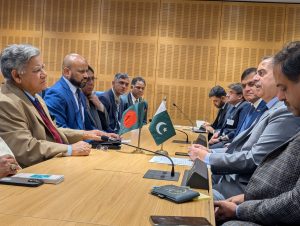
Mian Zahid Hussain, President Pakistan Businessmen and Intellectuals Forum and All Karachi Industrial Alliance, Chairman National Business Group Pakistan, Chairman Policy Advisory Board FPCCI, and Former Provincial Minister Information Technology, has welcomed the decision to increase and modernise the Pakistan National Shipping Corporation’s fleet. He said that this decision represents timely progress towards strengthening Pakistan’s trade sovereignty, energy security and foreign-exchange conservation.
Mian Zahid Hussain paid tribute to Prime Minister Mian Muhammad Shehbaz Sharif for directing the acquisition and leasing of additional ships and the preparation of a comprehensive plan to elevate PNSC to international standards. He said that the Prime Minister has correctly recognised that genuine economic sovereignty cannot be achieved by dependence on foreign shipping companies. Mian Zahid Hussain also appreciated Field Marshal Syed Asim Munir’s active role in promoting peace and strategic stability in the Gulf, which will ultimately turn into Pakistan’s economic benefits. He said that efforts to reduce regional tensions, strengthen relations with Gulf countries and restore commercial shipping through the Strait of Hormuz are extremely important for Pakistan’s energy security and exports.
Mian Zahid Hussain said that PNSC inducted three modern oil tankers—MT Karachi, MT Lahore and MT Quetta—during January and February 2026 at a combined purchase price of approximately US$193.15 million. These vessels added 272,039 deadweight tonnes of carrying capacity, increasing the number of PNSC-managed ships from 10 to 13. The corporation now operates eight tankers and five bulk carriers. This additional capacity will make the transportation of petroleum products more reliable and reduce dependence on foreign vessels, which are obtained through expensive spot chartering.
Mian Zahid Hussain said that, in accordance with the Prime Minister’s directions, PNSC is to further increase the number of its ships from 13 to 30 by the end of 2027. This programme includes the proposed addition of three to five feeder container ships, each having a capacity of 1,100–2,000 TEUs, by the end of 2026. The addition of five vessels would increase the number of PNSC-managed ships from 13 to 18 and provide vital shipping capacity for trade with Gulf countries, the Red Sea and South Asia. Depending on the final number and size of the vessels, the proposed feeder ships could provide combined nominal capacity of approximately 3,300–10,000 TEUs per sailing.
Mian Zahid Hussain also welcomed the construction of a 1,100-TEU container ship at Karachi Shipyard and Engineering Works at a cost of US$24.75 million. He said the project would promote Pakistan’s domestic shipbuilding and marine engineering industries. However, since its construction milestones extend to December 2027, chartered vessels may be required to meet immediate shipping requirements.
Mian Zahid Hussain said that Pakistan’s exports to Gulf countries increased by 2.1 percent to US$1.944 billion during January–July 2026, while the UAE accounted for 65.9 percent of the total. Reliable Pakistani feeder connections to Fujairah, Khor Fakkan, and other regional hubs can protect exporters of food products, textiles, rice, surgical instruments, sporting goods, and engineering products from freight-rate volatility. He said that Pakistan reportedly pays approximately US$4.6 billion annually in freight charges to foreign shipping companies. Redirecting even a modest portion of this cargo to Pakistani-owned ships would conserve valuable foreign exchange and strengthen the bargaining power of Pakistani exporters.
Mian Zahid Hussain demanded that all ship acquisitions should be undertaken transparently, through competitive financing and on commercially viable terms. Assured two-way cargo, fixed weekly schedules, refrigerated containers, agreements with international mainline shipping companies and faster port clearance should be prioritised. He added that increasing the number of ships alone would not increase exports. Professional management, commercial discipline, modern ports and effective coordination among all relevant stakeholders are essential for achieving sustainable economic gains and export growth.