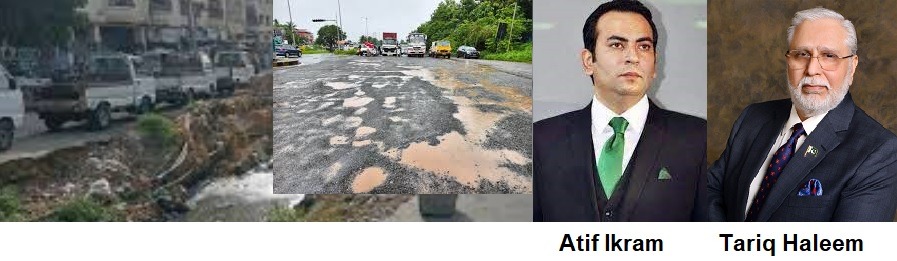
The extremely poor and deteriorated condition of the roads leading to East Wharf and West Wharf at Karachi Port continues to severely affect Pakistan’s import and export activities. President of the Federation of Pakistan Chambers of Commerce and Industry (FPCCI), Atif Ikram Sheikh, drew the attention of Sindh Chief Minister Syed Murad Ali Shah and Chairman of Karachi Port Trust (KPT), Rear Admiral Shahid Ahmed, to this issue through separate letters. However, despite these efforts, the condition of the roads connecting East Wharf and West Wharf has not improved.
According to sources, following the directives of the Chief Minister of Sindh, Section Officer VII, Dhani Bux Bhutto, issued a letter (No. SO(VII)/CMS/LGD/1(4)2025-1088/1198) to Mayor Karachi Syed Murtaza Wahab, instructing him to immediately address the deteriorated condition of the roads leading to East Wharf and West Wharf. The letter further directed that implementation of the Chief Minister’s instructions be ensured in accordance with applicable laws, rules, regulations, and policies, and that progress be updated on the Chief Minister’s portal.
However, despite four months having passed, the Mayor of Karachi has allegedly failed to act on the Chief Minister’s directives, and the roads leading to East Wharf and West Wharf remain in poor condition. As a result, import and export operations continue to face significant difficulties.
Meanwhile, Tariq Haleem, Chairman of the FPCCI Advisory Council for the Maritime Sector, also expressed concern over the deplorable condition of the roads leading to East Wharf and West Wharf. He emphasized that there should be free movement to and from the port so that import and export activities can continue smoothly and commercial operations are not adversely affected.
In his letters to Chief Minister Syed Murad Ali Shah and KPT Chairman Rear Admiral Shahid Ahmed, Atif Ikram Sheikh stated that Karachi Port handles a major portion of the country’s maritime trade, including containerized cargo, bulk commodities, petroleum products, and industrial raw materials. He regretted that the road infrastructure connecting the East Wharf and West Wharf terminals has been severely damaged due to continuous movement of heavy vehicles, a substantial increase in container traffic, lack of timely maintenance and rehabilitation, and outdated road designs that are no longer suitable for current trade requirements and cargo volumes.
He further pointed out that excessive dust, mud, filth, solid waste, stones, and debris on these roads—particularly in the area from beneath the Jinnah Flyover to West Wharf Road—have worsened the situation. Poor traffic management, illegal parking, encroachments, and the lack of effective administrative measures have also become serious concerns, severely disrupting cargo and passenger movement.
Atif Ikram Sheikh highlighted several key issues observed on these roads, including:
Deep ruts, potholes, and severe surface damage.
Persistent traffic congestion and bottlenecks.
Increased vehicle breakdowns and traffic accidents.
Excessive wear and tear on commercial and freight vehicles leads to higher maintenance costs.
Delays in cargo transportation and handling increase logistics and operational expenses.
Negative impacts on port efficiency and business confidence.
He stated that these problems are not only disrupting port operations but are also adversely affecting national trade, government revenues, and Karachi’s vital economic role. Transporters, clearing agents, exporters, and importers face practical difficulties daily, resulting in financial losses and reputational concerns for Karachi Port. Moreover, ordinary citizens who use these roads regularly face significant inconvenience and serious safety hazards.
Given the gravity of the situation, Atif Ikram Sheikh urged the Karachi Port Trust to take immediate notice of this critical issue, which is affecting KPT’s institutional image as a dynamic and efficient organization. He emphasized that urgent remedial measures are essential in the broader interest of national trade and economic development.