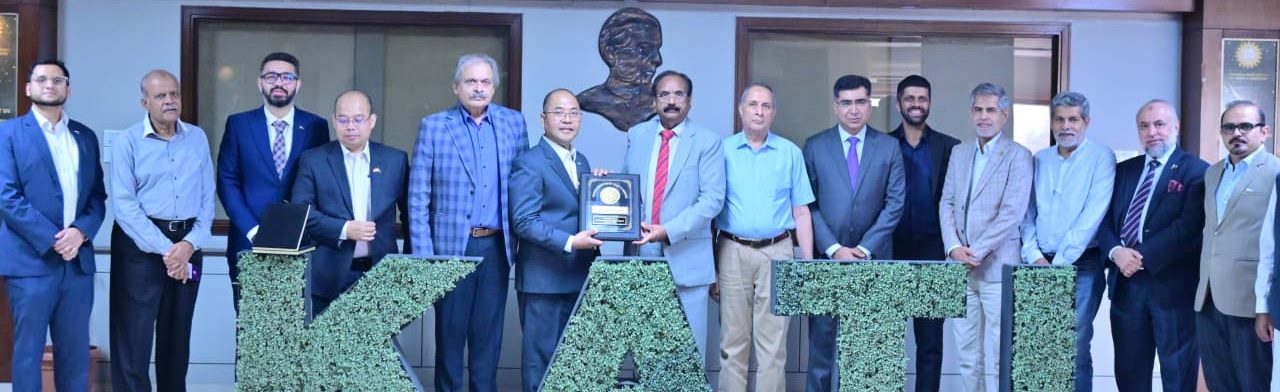
Indonesian Consul General in Karachi Mudzakir M.A. invited industrialists from the Korangi Association of Trade and Industry (KATI) to participate in Trade Expo Indonesia 2026, scheduled to be held in Jakarta from October 14. He said that progress on preferential trade arrangements between Pakistan and Indonesia was essential, and that a Comprehensive Economic Partnership Agreement (CEPA) was particularly important.
He expressed these views while addressing industrialists during his visit to the Korangi Association of Trade and Industry (KATI). KATI President Muhammad Ikram Rajput, Deputy Patron-in-Chief Zubair Chhaya, Senior Vice President Zahid Hameed, Vice President Muhammad Talha Ali, Chairman of the Standing Committee Rashid Siddiqui, former president Junaid Naqi, Farukh Mazhar, Honorary Consul General of Ethiopia Ibrahim Tawab, Iqbal Baig, Dr. Ahmed Sufyan of the Indonesian Consulate, and a number of KATI members and industrialists attended the event.
Consul General Mudzakir said KATI was one of Pakistan’s largest and most active industrial zones. He assured that the Indonesian Consulate would provide special assistance to KATI’s industrialists in visa-related and other diplomatic matters.
He said the trade expo in October would showcase products from a wide range of sectors, including halal products, spices, construction materials, automobiles, chemicals, furniture, fashion and textiles, handicrafts and other industries. More than 1,600 exhibitors from 130 countries are expected to participate in the expo.
The Consul General said Pakistani industrialists could benefit from Indonesia as a base for re-exporting products to international markets. He stressed that increasing business-to-business (B2B) linkages between Pakistani and Indonesian industrialists and traders should be given priority, adding that the Indonesian Consulate was ready to provide all possible assistance in this regard.
Earlier, KATI President Muhammad Ikram Rajput said Indonesia was the largest economy in Southeast Asia. He said bilateral trade between the two countries stood at $4.2 billion in 2024 and increased to $4.7 billion in FY2024-25. However, he noted that the current trade volume remained below its actual potential and was significantly imbalanced.
He said Indonesia’s exports to Pakistan accounted for approximately $3.44 billion of the total trade, including $2.59 billion in palm oil, while raw fibres, paper and coal were also among the major imports. In comparison, Pakistan’s exports to Indonesia stood at around $621 million, mainly comprising rice, raw tobacco and textiles. As a result, the bilateral trade deficit in Indonesia’s favour exceeded $2.8 billion.
The KATI president said both countries needed to address the ground realities and practical hurdles faced by industrialists to establish a sustainable economic partnership.
He said Pakistan and Indonesia should move beyond commodity-based trade towards high-value industrial partnerships to make bilateral trade more sustainable in the future. He proposed establishing a dedicated “Indonesia Desk” at KATI to facilitate Indonesian investors and business enterprises regarding investment opportunities and business prospects in Pakistan.
Muhammad Ikram Rajput stressed that stronger direct B2B linkages, improved air and sea connectivity, removal of trade barriers and enhanced industrial cooperation could take Pakistan-Indonesia economic relations to new heights. He said both countries should prioritize joint investment, technology cooperation, and value-added industrial partnerships rather than relying solely on traditional commodity trade.
Deputy Patron-in-Chief Zubair Chhaya said Indonesia had stood by Pakistan during difficult times, which was a major reason for the friendly and fraternal relations between the two countries.
He said there was significant potential to expand bilateral trade, particularly in textiles, ready-made garments, leather, engineering products, pharmaceuticals, halal food, palm oil, and agricultural products. However, he noted that trade between the two countries remained unbalanced.
Zubair Chhaya said Indonesia was a strong economic and industrial power, and Pakistan could work with it not only in traditional trading sectors but also in new technologies, investment and industrial cooperation.
He said a KATI trade delegation would participate in the upcoming expo in Jakarta. He added that since 2022, Pakistan had become increasingly dependent on imports, and the industry’s priority was now to explore alternative sources and reduce import dependence, an area in which Indonesia could provide significant support to Pakistan.
Chairman of KATI’s Standing Committee, Rashid Siddiqui, said that increasing the volume of trade between Indonesia and Pakistan would be beneficial for both sides. He said around 90 percent of Pakistan’s edible oil, particularly palm oil, was imported from Indonesia.
He said trade relations between the two countries had existed for decades, but barriers to Pakistani exports to Indonesia needed to be removed through greater bilateral cooperation and consultation. He added that joint business forums, exchanges of trade delegations, and the creation of tourism and investment opportunities could help increase bilateral trade.
KATI Senior Vice President Zahid Hameed, Dr. Ahmed Sufyan of the Indonesian Consulate, and Honorary Consul General of Ethiopia Ibrahim Tawab also addressed the gathering and shared their views on the growing trade opportunities between Pakistan and Indonesia.