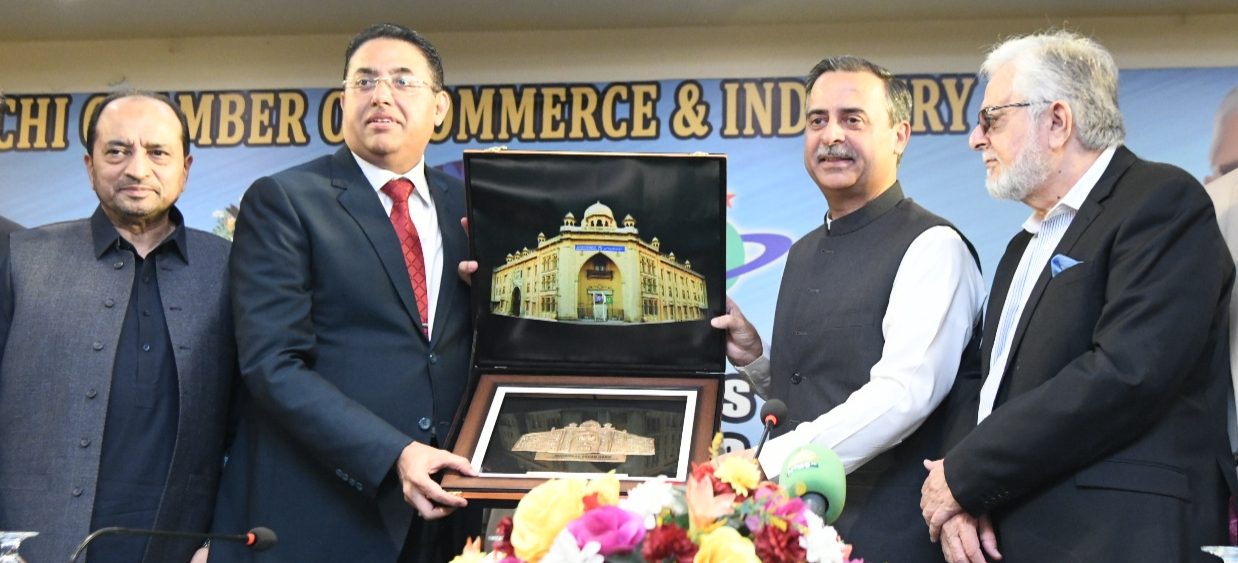
Federal Minister for Maritime Affairs Muhammad Junaid Anwar Chaudhry has announced the establishment of a modern small industrial estate at Port Qasim, spanning approximately 400 acres, to promote industrialisation and enhance investor confidence.
Speaking during his visit to the Karachi Chamber of Commerce & Industry on Thursday, the Minister stated that the development strategy would prioritise infrastructure readiness before plot allocation. “Unlike conventional practices where investors are shown undeveloped land, this project will first deliver fully developed infrastructure, including main boulevards, landscaping, and essential utilities, ensuring a business-ready environment prior to allotment”, he said.
Chairman Karachi Port Trust Rear Admiral Shahid Ahmed, Chairman Businessmen Group Zubair Motiwala, President KCCI Muhammad Rehan Hanif, Senior Vice President Muhammad Raza, Vice President Arif Lakhani, Chairman Maritime Affairs Subcommittee Nausherwan Haider, former presidents Abdullah Zaki, Shamim Firpo, Junaid Makda, Iftikhar Sheikh, KCCI Executive Committee members, and senior KPT officials were also present on the occasion.
Referring to the recent surge in transhipment activity amid regional geopolitical developments, including disruptions linked to the Strait of Hormuz, he stated that Pakistan handled a record number of container ships within just 24 days. “While such extraordinary volumes were driven by external circumstances, the real achievement lies in demonstrating Pakistan’s operational capability to efficiently manage volumes within days that would typically take months under normal conditions”, he remarked, while commending KPT officials and workforce for their exceptional commitment.
Highlighting measures to enhance Pakistan’s competitiveness in the global maritime sector, the Minister stated that port charges have been reduced by up to 60 per cent to attract international shipping lines. He further noted that capacity enhancements, including expansion of off-dock and on-dock terminal areas, and clearance of decades-old abandoned cargo and containers, have significantly improved port efficiency. A high-level facilitation committee, comprising senior officials, including Chief Collector of Customs Wajid Ali and Member of Customs Operations Shakeel Shah, was constituted to fast-track decision-making and resolve longstanding issues within hours rather than weeks.
He also informed that initiatives are underway to introduce Roll-on/Roll-off (RoRo) shipping facilities to facilitate vehicle imports, supported by dedicated storage and parking infrastructure at the port, which is expected to open new avenues for trade and logistics. Praising KPT’s performance, he stated that the institution, which once faced serious operational challenges, has now emerged as a high-performing entity that contributes effectively to national economic growth.
He further appreciated the role of Pakistan National Shipping Corporation, stating that its proactive deployment of fleet capacity at minimal margins during challenging times ensured uninterrupted fuel supply, thereby preventing shortages and supporting industrial continuity.
Focusing on governance reforms at Port Qasim, the Minister stated that strict measures have been implemented to curb land misuse and speculative trading. Investors are now required to submit feasibility plans, establish industrial units, and ensure operationalisation before any transfer of ownership is permitted. The sale of undeveloped plots has been disallowed, ensuring that land allocation is strictly tied to genuine industrial activity. A dedicated committee has also been established to resolve property-related issues within weeks, significantly reducing delays.
He further announced that the Port Qasim Authority Board has approved a development budget of Rs35 billion for the Eastern Zone, where infrastructure development will commence shortly.
Addressing concerns regarding inundated plots at Port Qasim, the Minister acknowledged that land reclamation would require prohibitively high investment. He stated that the government is formulating a policy to offer affected allottees a refund or alternative developed plots, subject to submission of viable industrial plans.
Chairman KPT, Rear Admiral Shahid Ahmed, pointed out that transhipment activities contribute to national revenue through formal channels, while delays in container clearance are primarily linked to the late filing of Goods Declarations (GDs), necessitating procedural improvements.
He emphasised the strong potential of Pakistan’s growing bunkering industry, stating that Karachi Port has already serviced over 100 vessels and that the sector is expected to generate billions of rupees in business within the next two years, while also supporting growth in the refinery sector. He added that the number of bunkering vessels will increase to three by next year and encouraged the business community to invest in this emerging segment.
Chairman BMG Zubair Motiwala appreciated the Ministry of Maritime Affairs for introducing a range of reforms to improve the efficiency and performance of the maritime sector. He also commended the leadership of the Prime Minister and the Field Marshal for enhancing Pakistan’s global standing and restoring national confidence.
He further stressed that while the Karachi Chamber is regulated by the DGTO, there is a pressing need to establish an effective regulatory framework for shipping lines as well.
Zubair Motiwala also drew attention to the persistent delays in plot allotment matters at Port Qasim and urged the authorities to resolve these issues on a priority basis. While supporting reforms in the maritime sector, he cautioned that such initiatives must be practical and result-oriented, expressing reservations over approaches similar to the ‘Uraan Pakistan’ model.
He acknowledged the recent surge in transhipment activity, terming the handling of thousands of vessels as a significant achievement, and appreciated the Ministry’s efforts in delivering tangible results. He further emphasised the importance of formulating long-term, sustainable policies grounded in realism that effectively support trade and industry.
President KCCI Rehan Hanif, while welcoming the Maritime Minister, appreciated the Ministry of Maritime Affairs’ continued engagement, noting that the Minister’s second visit in six months reflects the government’s commitment to addressing the concerns of the business community. He acknowledged the recovery of over 210 acres of valuable KPT land, terming it a significant achievement.
He highlighted that recent geopolitical developments in the Middle East have led to increased transhipment activity towards Pakistan and emphasised the need to convert this temporary shift into a sustainable, long-term opportunity. He stressed that enhanced transhipment volumes must translate into tangible revenue for the government and terminal operators.
Drawing attention to structural challenges, he pointed out that Pakistan incurs an annual freight bill of approximately $5 to $6 billion, which places considerable pressure on foreign exchange reserves. He underscored the importance of strengthening Pakistan’s own container shipping capabilities to reduce reliance on foreign shipping lines. He further remarked that, despite the government’s efforts to secure relatively smaller external inflows, significant outflows continue through freight payments.
President KCCI also emphasised that while Pakistan’s ports have adequate capacity and have demonstrated resilience by maintaining uninterrupted operations during Eid-ul-Fitr, including active participation of staff across all levels, there is a critical need to further enhance service quality to ensure long-term retention of international transhipment clients.
Highlighting regulatory gaps, he stated that shipping agents and lines are currently operating without adequate oversight and called for the establishment of a dedicated regulatory authority. In this regard, he informed that KCCI has already formulated detailed recommendations to regulate shipping lines and improve governance in the maritime sector.


