Growing concerns over the ethical vacuum and fragmented understanding fostered by dominant Western knowledge systems have underscored the urgent need to reassess contemporary epistemologies through the lens of Islamic tradition. The Islamic concept of knowledge promotes the holistic development of the human personality, building upon moral and spiritual foundations to enhance information, knowledge, and skills. A system of thought and education grounded in social realities and religious principles can serve as an effective means to address global crises and promote human dignity.
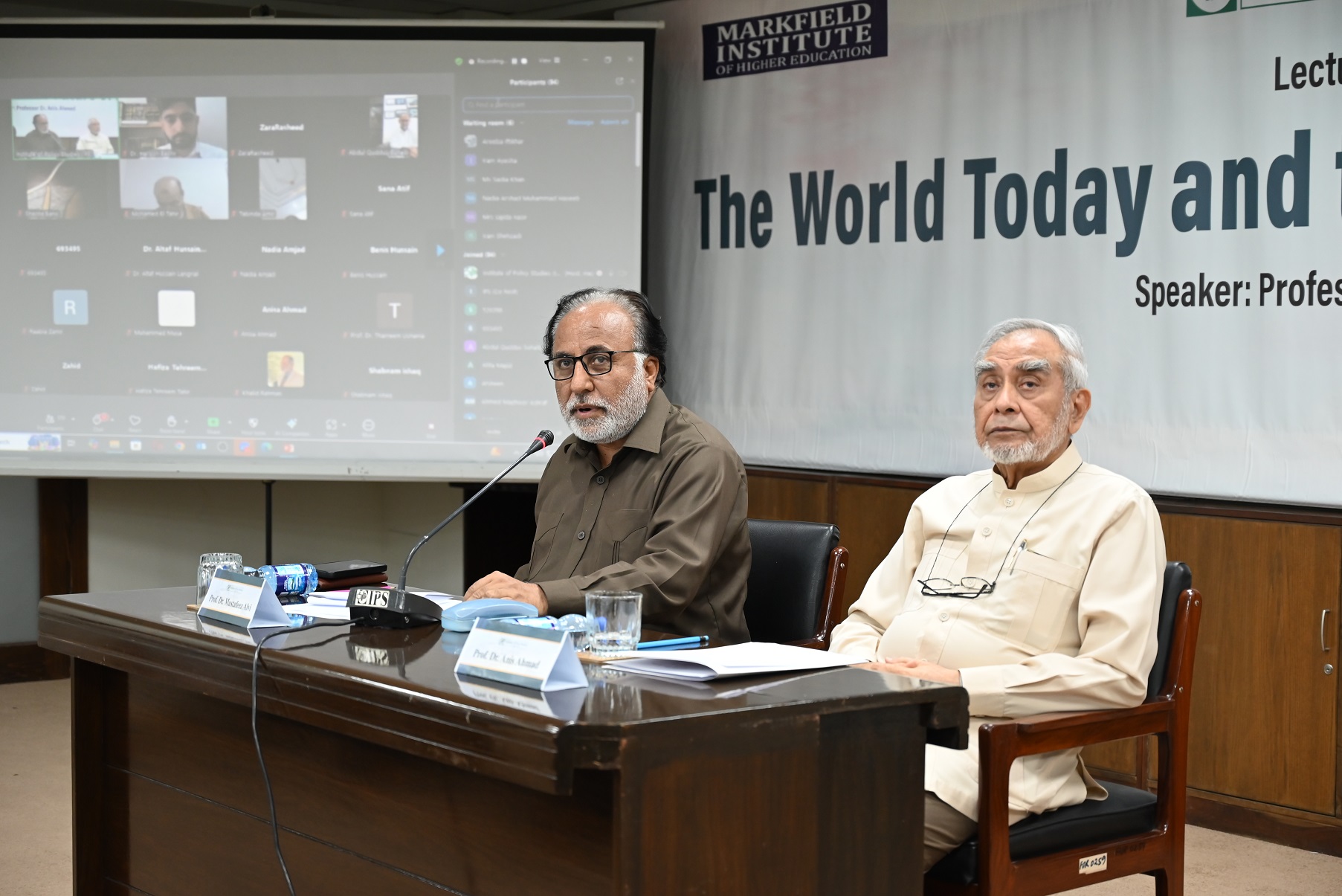
This was observed by Prof. Dr. Anis Ahmad, renowned scholar and vice-chancellor of Riphah International University, while delivering a seminal lecture titled “Revisiting the Concept of Knowledge,” at the Institute of Policy Studies (IPS), Islamabad, as part of its lecture series “The World Today and the Future of Humanity.”
The event was organised in collaboration with the Markfield Institute of Higher Education (MIHE), UK, the International Institute of Muslim Unity, Malaysia, and the Islamic Studies Department at Bahauddin Zakria University (BZU), Multan. Dr. Haroon Bashir, Head of Research at MIHE, and Dr. Abdul Quddoos Sohaib from BZU also spoke on the occasion. Prof. Dr. Mustafeez Ahmad Alvi moderated the event.
In his address, Dr. Anis Ahmad critiqued the prevailing Western paradigms of knowledge, which he said have contributed to global ethical disorientation, deepening inequalities, and environmental degradation. He emphasised that the modern commodification of knowledge has reduced it to an economic and bureaucratic tool, severing it from its spiritual, moral, and holistic dimensions.
He argued for a revival of the Islamic concept of knowledge, which rests on tawheed (divine unity) and wahi (revelation) as its foundational sources. Prof. Ahmad underscored that in Islam, knowledge is not merely an intellectual exercise but a moral and transformative endeavour that connects human beings to their Creator and one another through justice, ethical responsibility, and the pursuit of the common good.
Citing examples from classical Islamic thinkers such as Ibn Sina and Ibn Arabi, he highlighted their efforts to integrate reason, revelation, and spiritual insight. He pointed to the Qur’anic emphasis on concepts like tafaqquh (deep understanding), ta’aqqul (rational reflection), and tadhakkur (moral remembrance), stressing the need to reconstruct educational and epistemic frameworks grounded in these principles.
The lecture concluded with a call for intellectual decolonization and a rejuvenation of Muslim educational institutions that not only produce functional knowledge but also cultivate wisdom (hikmah), ethical behavior, and holistic human development.
Dr. Haroon Bashir identified that Eurocentric approaches were implanted in Muslim and other non-Western societies through colonization and sustained through neo-colonial strategies.
Dr. Abdul Quddoos said that the thoughts generated from the scholarly discussion marked a meaningful contribution towards building an Islamic epistemic paradigm rooted in transcendence, ethics, and human dignity.
The event was attended by a large number of scholars, educators, students, and researchers from different universities, regions, and countries, in-person and online. #