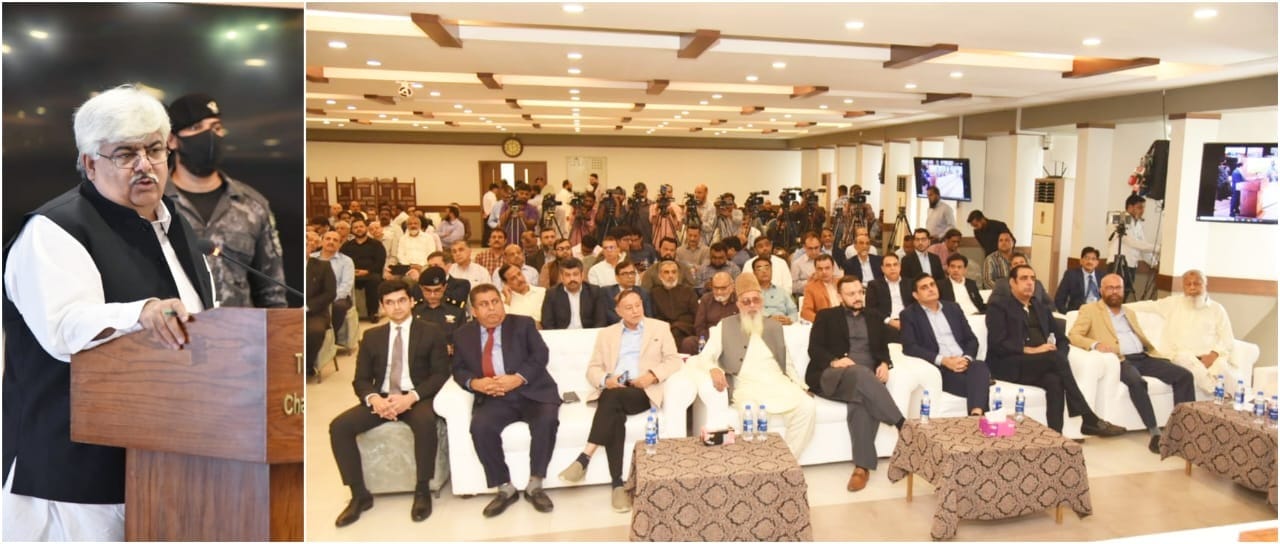
Mr. Atif Ikram Sheikh, President of FPCCI, has apprised that, in a milestone development, FPCCI and FBR have agreed to consult, collaborate, and synergize on a comprehensive taxation reform agenda. This is the only way forward for the economy of Pakistan as revenue generation provides the very basis of any country’s fiscal policies and development plan – nonetheless, the same needs to be done in a consultative, inclusive and pragmatic manner, he added.
It is pertinent to note that Mr Rashid Mahmood Langrial, Chairman of the Federal Board of Revenue (FBR), paid a detailed visit to the Head Office of FPCCI – the apex body – at the Federation House, Karachi. He was accompanied by a C-level FBR team and senior officials from various FBR departments, who collectively responded to questions from senior trade, industry and media representatives.
Mr. Atif Ikram Sheikh reiterated his earlier stance that the two guiding principles of any taxation reforms in Pakistan should be broadening the tax base, simplifying the taxation system, and rationalising tax rates, facilitation, and incentivizing a taxation culture.
Mr. Saquib Fayyaz Magoon, SVP of FPCCI, presented FPCCI’s principled apprehensions and demands. He observed that FBR’s revenue target is PKR. 12.97 trillion—representing a 40 per cent YoY increase—while the economy is growing at only 2 per cent. This is a huge cause of concern for the business community and may result in new taxes, mini budgets, and taxing the already taxed even further.
Mr Saquib Fyyaz Magoon maintained that the Finance Bill has significantly reduced the business community’s confidence in government policies due to the abrupt withdrawal of 1 per cent full and final liability for exporters and the sales tax exemption on local supplies to registered exporters authorized under the Export Finance Scheme (EFS).
SVP FPCCI highlighted that the Tajir Dost Scheme (TDS) was also implemented without consultation. TDS has been revealed to have missed its revenue collection target by 99%.
Mr. Magoon stressed that FPCCI has repeatedly raised the issue of SRO. 350 (I)/2024, and despite being amended twice over, it remains problematic just because it was issued without consulting the stakeholders. He added that FPCCI strongly advocates effectively reviving and expanding Alternate Dispute Resolution Committees (ADRCs) under customs, sales tax, federal excise duties, and income tax heads.
Mr Saquib Fayyaz Magoon proposed simplifying the Export Finance Scheme (EFS), which takes 3 – 4 months to complete due to complex procedures, issues of duplicate documentation, and system glitches. Additionally, it lacks provisional quotas, which means transitioning between business structures and multi-product output from single inputs.
Mr Magoon warned that including EPZs in the regular tax schemes would result in major losses and investor resentment. Additionally, the local industry has been excluded from EFS, and exporters have been unfairly excluded from the final x regime (FTR). He added that FPCCI once again demands the resolution of these discrepancies.
Mr Khurram Ejaz, a member of PM’s committee on cross-cutting in ports and advisor to President FPCCI on FBR affairs, questioned why Pakistani ports and terminals cannot operate 24 / 7 examination, delivery, and handling like the rest of the world. He demanded that FBR’s LIVE project be implemented to resolve issues of customs appraisal, modernized labs be installed, and dwell times be reduced.
Mr. Rashid Mahmood Langrial, Chairman of FBR, agreed that tax rates should be curtailed to reduce the tax burden and enhance compliance; however, this is not possible in the current circumstances. He added that the last two to three years have been painful for the economy, but economic indicators have improved.
The FBR Chairman also expressed optimism that the interest rate may be further reduced by 1.5 – 2.0 per cent soon and advocated for no more than a 3 – 4 per cent premium in the policy rate compared to inflation numbers. He opined that the country has no other breathing windows in sight and that promoting a tax culture is the only viable solution.
Mr Langrial stated that not even the top 5 per cent of the wealthiest population is filing taxes and FPCC. FPCCI’s legitimate that tax evaders should be targeted instead of those paying taxes for many decades. He also suggested that the model of paying back loans through borrowing even more money is no longer sustainable for the country.
On the demand of FPCCI, he advised FBR officials to minimize checking cargo within the limits of Karachi city as a pilot study and only inspect or s on concrete intelligence-based information for large consignments. He also advised appointing a grade-19 FBR officer in his staff to be the focal person for day-to-day issues raised by trade bodies, who should be responsible for informing him of any pressing concerns or complaints within 24 hours.