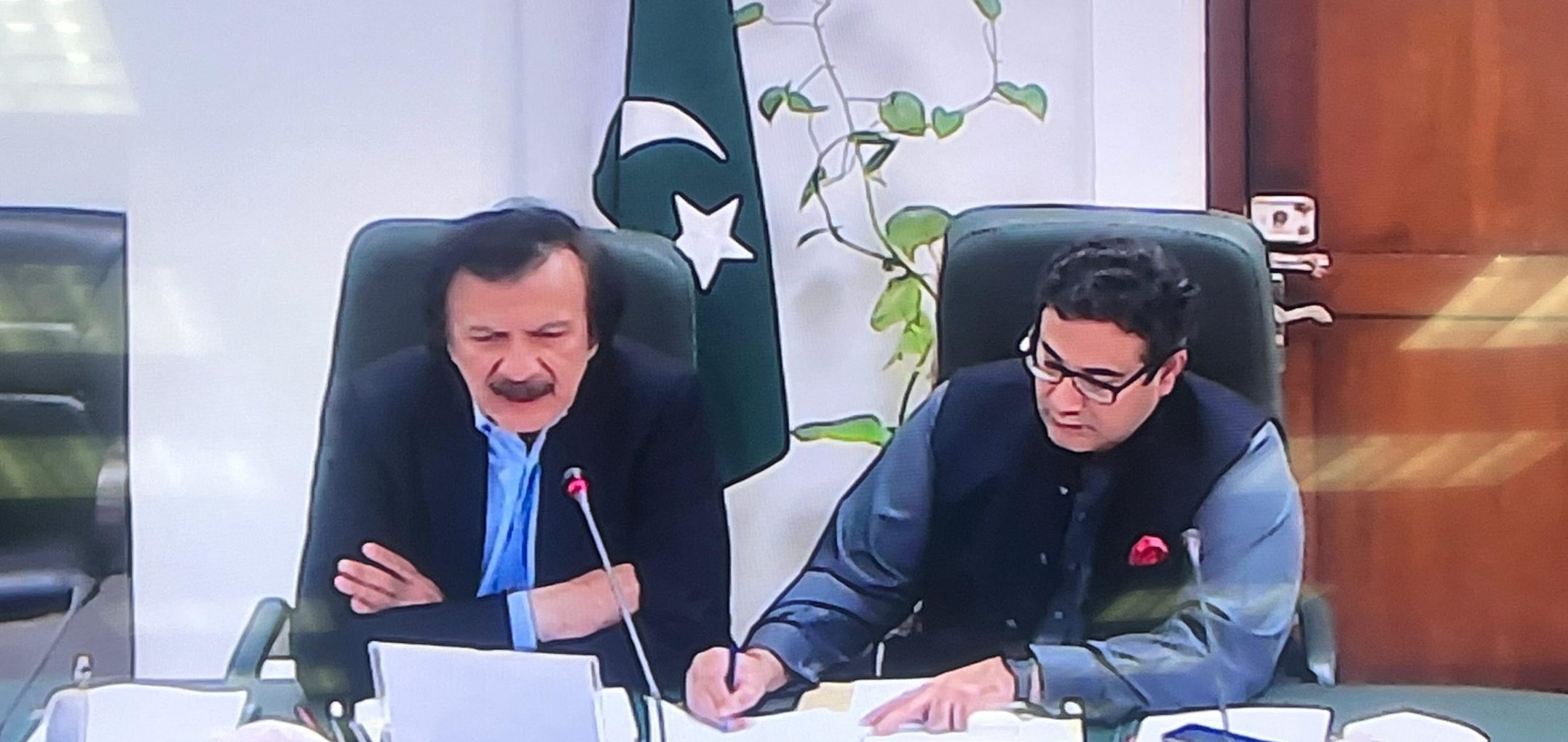
The Small and Medium Enterprises Development Authority (SMEDA) of the Ministry of Industries and Production successfully hosted the First Virtual Session and the 8th Meeting of the D-8 SME Governmental Bodies today. Representatives from Azerbaijan, Bangladesh, Indonesia, Malaysia, Nigeria, Pakistan, and Türkiye participated in the high-level forum.
The virtual session was also addressed by Mr. Haroon Akhtar Khan, Special Assistant to the Prime Minister on Industries and Production, H.E. Ambassador Isiaka Abdulqadir Imam, Secretary-General of the D-8 Organization for Economic Cooperation, and Mr. Socrat Aman Rana, Chief Executive Officer of SMEDA, who moderated the meeting as the host. The representatives of the nine above-mentioned member-states attended the virtual meeting and gave a presentation on SME development measures of the respective governments.
In his address, Mr. Haroon Akhtar Khan said that under the vision of Prime Minister Muhammad Shehbaz Sharif, Pakistan is committed to transforming SMEs into engines of sustainable growth and drivers of a comprehensive industrial revolution. He emphasized that SMEs contribute about 40 percent of GDP in developing economies, and their strength is essential for job creation, innovation and poverty reduction. “SMEs are the backbone of our economy and the foundation of regional economic integration, he said, adding that Pakistan’s SMEs, especially in the textile, surgical, IT, and sports sectors, light engineering, agro-based products, and food processing, are globally recognized, and we are committed to enhancing their competitiveness.”
He informed that the government of Pakistan, under the leadership of the Prime Minister, was working hard to meet the challenges in “Lack of financial resources, technology gaps, and market access for SMEs. “We are committed to aligning its SME policies with global standards, ensuring inclusiveness and involving all stakeholders,” he said.
Secretary Industries and Production, Mr. Saif Anjum, emphasized that the D-8 cooperation framework provides a platform for member countries to join the global value chain, which will open new avenues for regional cooperation and industrial development. He said that Pakistan remains committed to advancing economic diplomacy in the region and making SMEs a central pillar of growth and global competitiveness.
He appreciated that the eighth meeting of D-8 SME governmental bodies had identified the role of SMEs as key in achieving the Sustainable Development Goals (SDGs), focusing more on access to financing, digital transformation, green initiatives, and empowerment of youth and women. Through the D-8 SME collaboration agreement, we aim to promote B2B connections, build partnerships, share knowledge, and support sustainable and green development.
Mr. Socrat Aman Rana, CEO of SMEDA, moderating the session as host of the meeting, welcomed the delegates and highlighted the significance of SMEs for D-8 Member states. He said, “SMEs are the backbone of our economies—representing over 90% of businesses globally, contributing more than 50% of employment, and nearly 40% of GDP in emerging markets like ours. By 2030, SMEs are projected to generate more than 70% of new jobs,” he said, and hoped that the new D-8 SME Cooperation Framework would strengthen internationalization, global value chain integration, and international market development. “Together, our nine nations—representing a market of over 1.3 billion people have the potential of raising collective trade volume up to 2 trillion US dollars, he said.
H.E. Ambassador Isiaka Abdulqadir Imam, Secretary-General of the D-8, highlighted the role of the D-8 SME Development frame work in developing cooperation among the nine member states. He informed that total volume of trade among D-8 countries was $157.06 billion in 2024, with a 10% increase from the previous year. The D-8’s ambitious goal is to reach a total intra-trade volume of $500 billion by 2030 under its Decennial Roadmap and the D-8 Preferential Trade Agreement (PTA), he said and added that Centre for SMEs set up in Nigeria was being developed as a hub of excellence in SME development across member states by advancing innovation, financing, and digital integration, the D-8 SME Cooperation Framework is evolving into a strategic economic engine for sustainable development, job creation, and competitiveness.
The session concluded with presentations from member states, outlining national SME development strategies and reaffirming collective commitment to strengthening SME ecosystems across the D-8 community.
During the discussion, the participants agreed to hold the meeting of D-8 SME governmental bodies at least twice a year and also evolve an effective roadmap to enhance operationalization of the Memorandum of Understanding for inter-member states cooperation on SME development. The participants decided to schedule the next meeting in Nigeria after six months.
Notably, Azerbaijan, Bangladesh, Egypt, Indonesia, Malaysia, Nigeria, Iran, Pakistan, and Türkiye are members of the D-8 Economic Cooperation Organization.