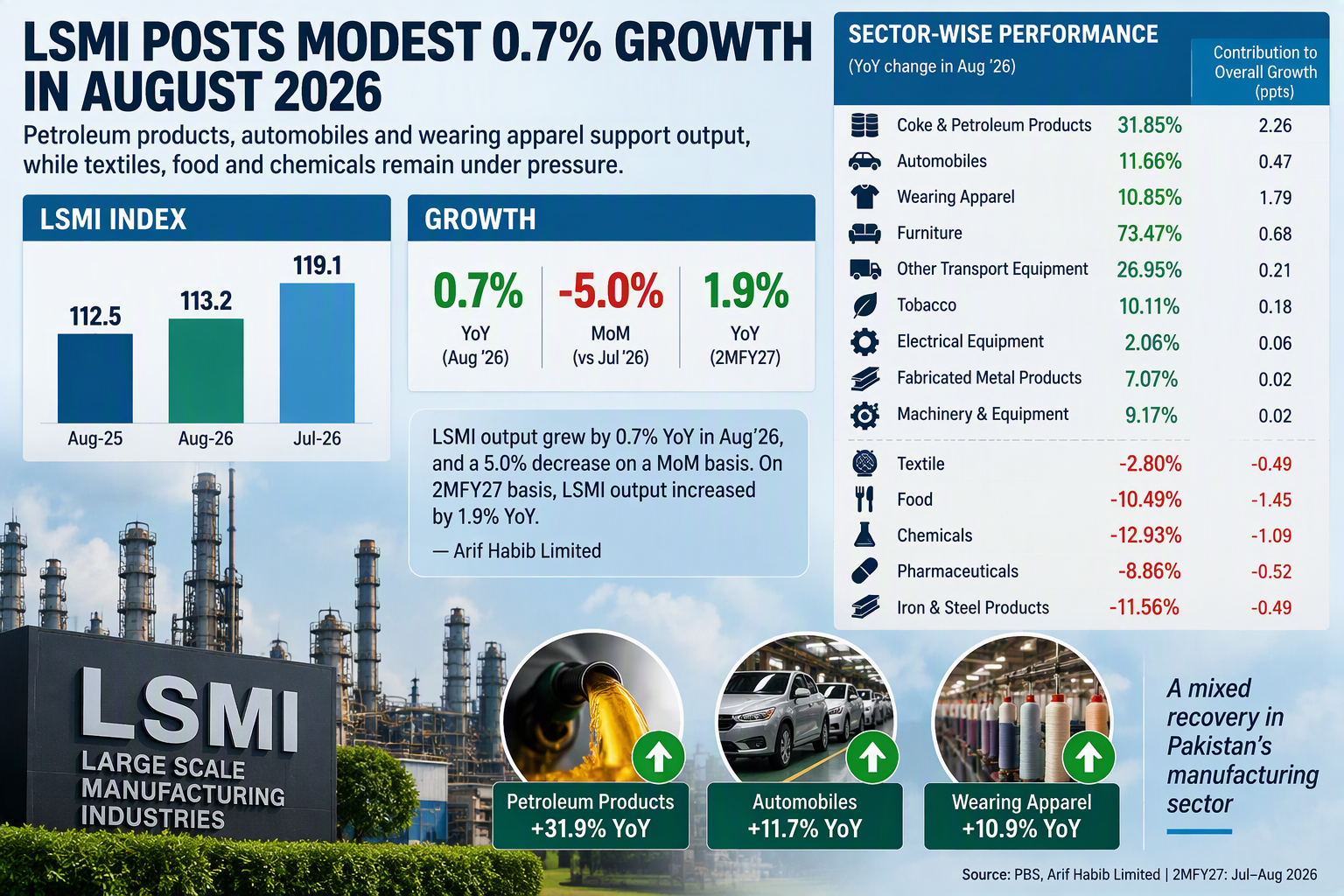
Pakistan’s Large Scale Manufacturing Industries (LSMI) posted modest 0.7 percent year-on-year growth in August 2026, while output fell 5.0 percent from July 2026, according to data compiled by the Pakistan Bureau of Statistics (PBS) and analyzed by Arif Habib Limited (AHL).
During the first two months of FY27 (2MFY27), the LSMI index rose 1.9 percent year-on-year, suggesting a gradual recovery in industrial activity despite weakness in several major sectors.
According to AHL Research, the LSMI index stood at 113.2 in August 2026, up from 112.5 in the same month last year. However, the index fell from 119.1 recorded in July 2026.
Sector-wise data showed mixed performance, with petroleum products, automobiles, wearing apparel and furniture emerging as key contributors to growth.
The coke and petroleum products sector contributed the most to overall industrial growth, expanding 31.9 percent year-on-year in August and 15.5 percent during 2MFY27. The sector added 2.26 percentage points to August’s overall LSMI growth and 1.17 percentage points to cumulative growth during the period.
The automobile sector also remained a strong performer, registering 11.7 percent growth in August and 32.5 percent in 2MFY27, supported by improving demand and production.
Similarly, wearing apparel output rose 10.9 percent year-on-year in August and 16.7 percent in the first two months of FY27, contributing notably to manufacturing growth.
Other sectors posting positive growth included tobacco, other transport equipment, furniture, fabricated metal products, machinery and equipment, and electrical equipment.
On the downside, several heavyweight sectors continued to face pressure. Food production declined 10.5 percent year-on-year in August, while textiles, which carry the largest weight in the LSMI basket at 18.2 percent, contracted by 2.8 percent. Chemical products fell 12.9 percent, pharmaceuticals declined 8.9 percent, and iron and steel products dropped 11.6 percent.
Analysts at Arif Habib Limited noted that while the overall industrial sector remained positive on a cumulative basis, growth remained uneven, with gains concentrated in selected sectors, particularly petroleum products and automobiles, while export-oriented and consumer-linked industries remained under pressure.
The 1.9 percent growth in 2MFY27 suggests Pakistan’s manufacturing sector is on a gradual recovery trajectory, although persistent weakness in key sectors such as textiles, food, chemicals, and steel may continue to constrain broader industrial expansion in the coming months.