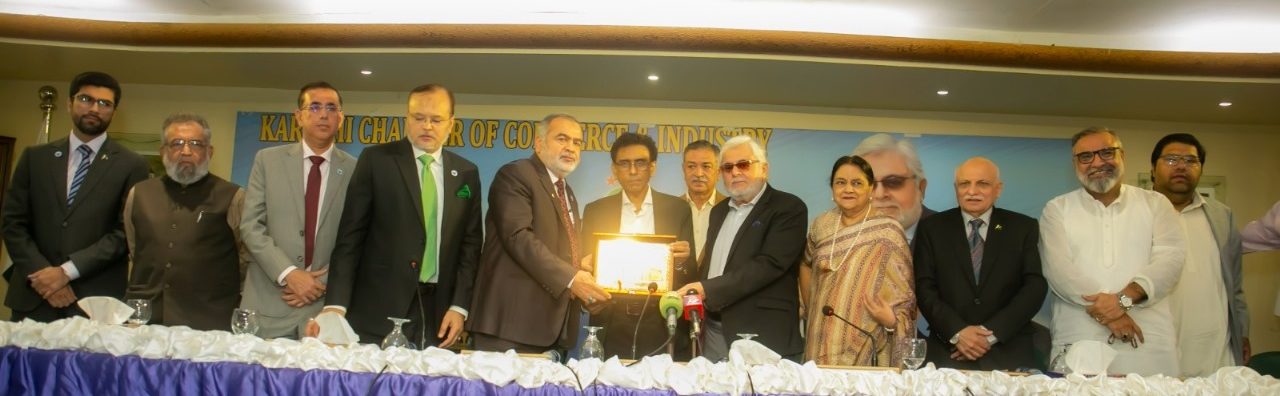
Federal Minister for Education & Professional Training, Dr. Khalid Maqbool Siddiqui, while speaking at a meeting during his visit to the Karachi Chamber of Commerce & Industry (KCCI) on Saturday, called for a proper and transparent census as delimitations and voters’ lists did not reflect the actual population of Karachi. He demanded fair representation and immediate corrections in electoral rolls, while also highlighting delays in the K-IV water project due to provincial inaction, despite federal allocations already being made.
Senator Amir Waliuddin Chishti, Senator Nasreen Jalil, MNA Arshad Abdullah Vohra, MPA Taha Ahmed, Chairman Businessmen Group Zubair Motiwala, President KCCI Muhammad Jawed Bilwani, Senior Vice President Zia ul Arfeen, Vice President Faisal Khalil Ahmed, Former Presidents Junaid Esmail Makda and Majyd Aziz, Chairman Education Subcommittee Faisal Anis Bumbia, KCCI Managing Committee Members, and others were also present on the occasion.
Dr. Khalid Maqbool further stated that despite Karachi being the country’s economic engine and holding a major share of Sindh’s population, the city had been deprived of its fair share in resources and development. He lamented that after Karachi University, no significant new public university had been established. At the same time, government schools in the metropolis had lost the trust of parents as “not a single child of Karachi is studying in a government school today.” To deal with this issue, 100 informal schools have been activated, he added, while requesting the business community to adopt these schools so that they could sustain.
Chairman BMG Zubair Motiwala, while congratulating the nation on the recently signed Pakistan–Saudi Arabia agreement, stated that the defense pact would not only strengthen bilateral security but would also expand cooperation in other important fields. He added that education and professional training would also benefit from such collaboration, ultimately preparing the nation for future challenges.
Commenting on the forthcoming Pakistan-India match on Sunday, Motiwala underscored the need to differentiate between sports and national security, noting that the Pakistan–India cricket match should be seen purely as a game, not as a war. “A cricket match cannot be equated with shooting down a Rafale jet”, he added.
Identifying education as the pressing issue being faced by Pakistan, Motiwala pointed out that Pakistan spends merely 1.9 percent of its national budget on education. At the same time, more than 24 million children remain out of school. He reminded that after the 18th Constitutional Amendment, education had become a provincial responsibility, and therefore urged the Federal Minister for Education to ensure allocation of special funds for Karachi, the country’s largest city and economic hub. He stressed that investment in education was the only sustainable path toward Pakistan’s progress, prosperity, and social uplift.
Earlier, while welcoming Dr. Khalid Maqbool, President KCCI Jawed Bilwani stated that Karachi is the economic lifeline of Pakistan. It is the country’s premier exporting and taxpaying city, contributing the lion’s share to the national exchequer. “Yet, paradoxically, this very city has been treated like an orphan. Despite its enormous sacrifices and contributions, Karachi continues to face neglect and injustice. This neglect has weakened the foundations of our economic hub and, by extension, of the entire nation.”
He emphasized that the elected MNAs and MPAs of Karachi carry a tremendous responsibility to ensure that the genuine issues of this city are resolved. However, the people of Karachi feel abandoned, as if their voices do not reach the corridors of power. This sense of injustice must be addressed without delay.
He said that if Karachi is made strong and healthy, it has the potential to eliminate the burden of external debt that continues to weigh heavily on our nation. A thriving Karachi is not merely Karachi’s success; it is Pakistan’s guarantee of prosperity and stability. “That’s why I often ask why Karachi is subjected to such indifference? Why are the aspirations of its people ignored?”
Bilwani stated, “In a city that contributes so much, one would expect to see world-class universities, timely completion of development projects, and reliable infrastructure. Yet, Karachi is deprived of basic facilities. To this day, we do not see a single new government university of the scale and standard that this city requires. Development schemes are announced but never completed within the promised timeframes. Citizens are burdened with excessive taxation, such as an 87 percent increase in municipal taxes, while infrastructure cess collections have reached Rs. 170 billion without a corresponding improvement in civic services.”
President KCCI noted that the mismanagement of electricity and gas supply has added to this misery, pushing us back to what can only be described as the Stone Age. How can industry survive, how can education flourish, and how can opportunities grow when basic utilities are not guaranteed, he asked, adding that this is clear evidence of the discriminatory treatment meted out to Karachi. It cannot be allowed to continue.