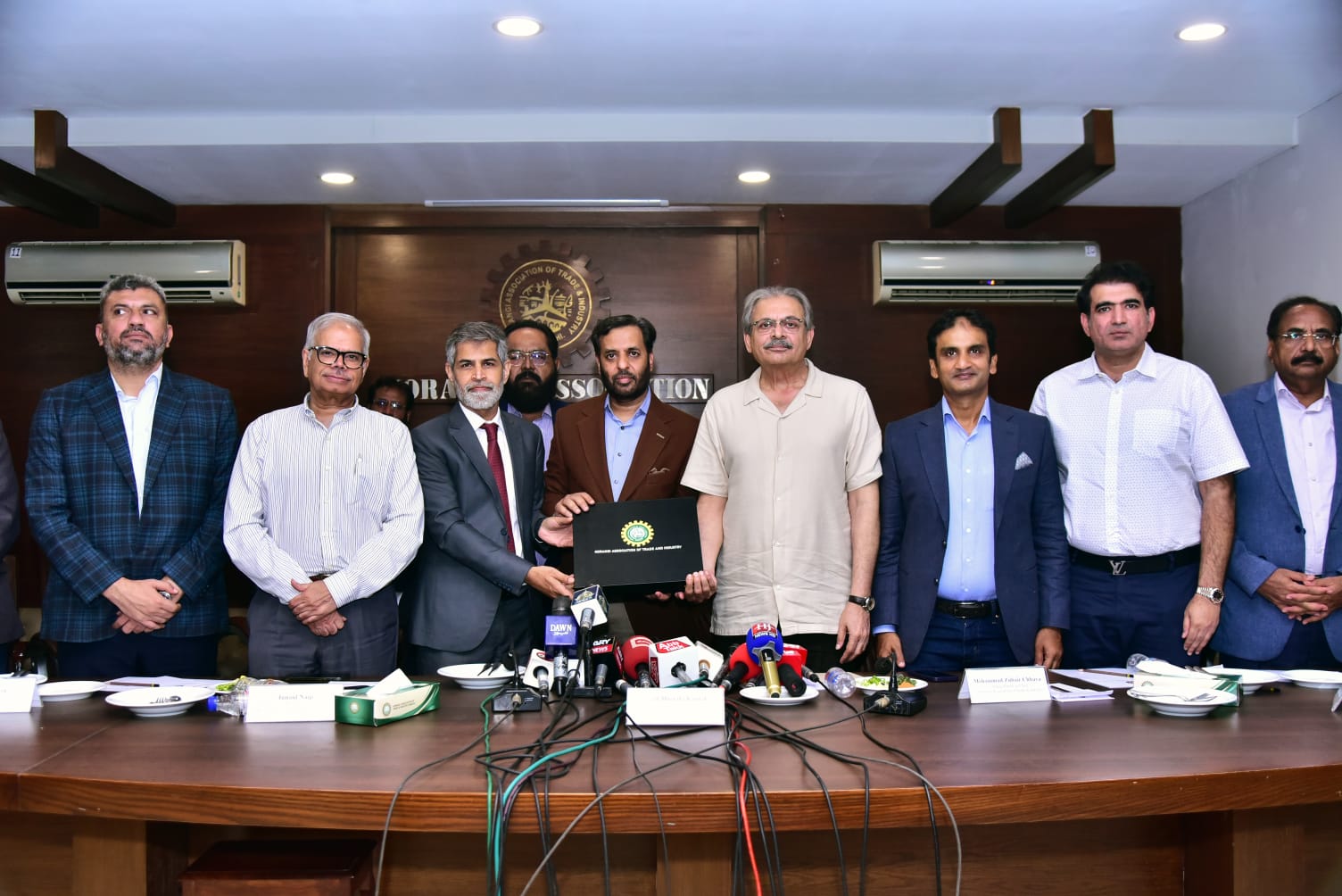
Federal Minister for Health Syed Mustafa Kamal has stated that fundamental flaws plague Pakistan’s healthcare system, and the solution lies not just in building hospitals, but in improving the entire environment. He expressed these views while addressing industrialists at the Korangi Association of Trade and Industry (KATI).
The event was attended by KATI President Junaid Naqi, Deputy Patron-in-Chief Zubair Chhaya, Senior Vice President Ejaz Ahmed Sheikh, Vice President Syed Tariq Hussain, Standing Committee Chairman Saleem-uz-Zaman, MPA Najm Mirza, former Chairman’s and Presidents Masood Naqi, Gulzar Feroz, Sheikh Umer Rehan and other notable members of the business community.
Mustafa Kamal warned that Pakistan’s population growth is outpacing its resources. “The annual population growth rate has reached a staggering 3.6%, compared to the national resource capacity,” he said. “If this is not addressed, disaster is inevitable.”
He further highlighted the dire conditions of healthcare facilities, citing the example of PIMS Hospital, where one doctor is expected to see 40 patients but currently attends to over 250. “Around 68% of diseases in Pakistan are caused by contaminated water, and we still lack a proper sewage treatment system,” Kamal added. “We don’t have a healthcare system; what we have is a sick care system.”
Kamal pointed out that Pakistan ranks among the highest globally in diabetes and hepatitis C cases, and while polio has been eradicated globally, it still persists in Pakistan and Afghanistan.
Emphasizing the role of technology, the health minister announced that reforms in the health sector would be introduced through a public-philanthropic partnership model. “The telemedicine service introduced during COVID-19 will now be expanded to ensure medicines and doctor consultations are delivered at the doorstep,” he stated.
Additionally, Kamal revealed that a collaboration with NADRA is underway to convert national identity card numbers into Medical Record Numbers (MRN), with legislation for this initiative expected soon.
Highlighting the shortage of nursing staff in Pakistan, the minister said, “We have only 170,000 nurses, but we need at least 900,000. Globally, there is demand for 2.5 million Pakistani nurses, potentially turning this sector into a multi-billion-dollar foreign exchange earner for Pakistan.”
Kamal underscored the need to strengthen the country’s primary healthcare infrastructure, pointing out that nearly 70% of patients in major hospitals suffer from minor illnesses that should be treated at primary healthcare centers. He stressed the strategic importance of Karachi, saying, “If this city were in someone else’s hands, its condition would have transformed by now. Though we lack authority, we are serving Karachi with full dedication.”
Earlier, KATI President Junaid Naqi highlighted that the Korangi Industrial Area is Pakistan’s economic engine, generating daily revenue of over Rs. 600 million and annual exports worth 4 billion US Dollar, employing nearly 2 million people. “Despite its contribution, Karachi continues to be neglected, particularly in healthcare facilities,” he said.
He lamented that industrial workers and their families face difficulties in accessing basic healthcare services. “It is extremely unfortunate that a city contributing so much to Pakistan’s economy faces such a severe shortage of hospitals and primary care facilities,” he added.
Calling for immediate action, Naqi demanded that the federal government allocate special funds for healthcare in Karachi, especially in the Korangi Industrial Area. “Healthy citizens form the foundation of a strong economy,” he noted. He also expressed concerns over the federal budget, stating that FBR’s policies are causing distress to the business community. “It’s time the Prime Minister gave Karachi the attention it deserves,” Naqi urged.
Deputy Patron-in-Chief of KATI, Zubair Chhaya, also expressed deep concern over the federal government’s continuous neglect of Karachi. “Road networks are being built across the country, but Karachi remains overlooked,” he said. “This city has consistently been the backbone of Pakistan’s economy, and it deserves immediate attention regarding both healthcare and economic development.”
Chhaya appreciated the health minister’s understanding of Karachi’s health crisis and welcomed the government’s new model based on technology and public participation. He praised Mustafa Kamal’s contributions to Karachi’s development during his tenure as Mayor, especially in developing industrial infrastructure.
Zubair Chhaya further highlighted that recent positive policies over the past six to eight months have resulted in an improvement in Pakistan’s export rate and welcomed the push towards digitization in institutions. “To strengthen Pakistan’s economy, we must unite to ensure Karachi’s comprehensive development,” he emphasized.
Speaking at the event, KATI Standing Committee Chairman Saleem-uz-Zaman highlighted that Pakistan’s leading pharmaceutical industries are located in Korangi, contributing significantly to national exports and revenue. He regretted that the pharmaceutical sector had not developed at the desired pace and hoped the federal health minister would play an active role, especially in obtaining FDA approval for Pakistani pharmaceutical products. “Such approval would not only boost exports but help Pakistan compete with neighboring countries in the sector,” he said.

