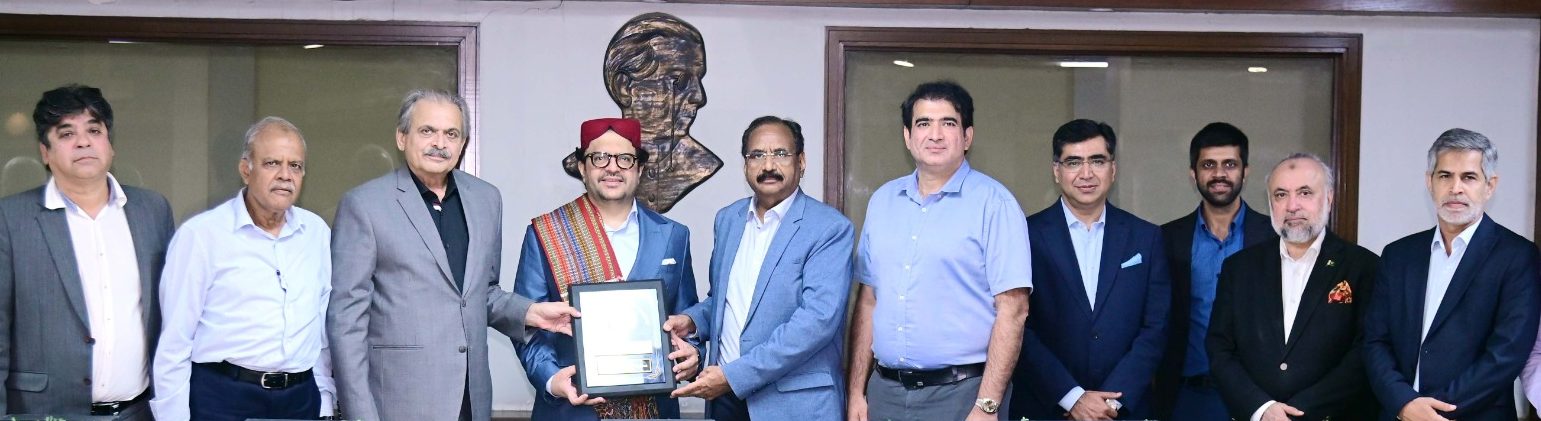
Director General of the Ministry of Foreign Affairs (MOFA) Liaison Office Karachi, Muhammad Irfan Soomro, has said that economic diplomacy has emerged as a central pillar of Pakistan’s foreign policy, with the Foreign Office playing an increasingly important role in promoting trade, investment and exports alongside traditional diplomacy.
He expressed these views while addressing industrialists during his visit to the Korangi Association of Trade and Industry (KATI). The meeting was attended by KATI President Muhammad Ikram Rajput, Deputy Patron-in-Chief Zubair Chhaya, Senior Vice President Zahid Hameed, Vice President Muhammad Talha Ali, CEO KITE Limited Saleem-uz-Zaman, former chairmen and presidents Junaid Naqi, Sheikh Umer Rehan, Farrukh Mazhar, Ehteshamuddin, and other industrialists and members.
Irfan Soomro described the industrial sector as the backbone of Pakistan’s economy, stressing that the government fully recognises that sustainable economic growth cannot be achieved without industrial development.
He acknowledged KATI’s significant contribution to Pakistan’s exports, foreign exchange earnings and economic stability, adding that the Foreign Office’s mandate now extends far beyond political diplomacy.
“The Ministry of Foreign Affairs is actively engaged in expanding Pakistan’s access to new markets, attracting foreign investment, promoting Pakistani products internationally and strengthening business-to-business relations through its embassies and trade missions across the world,” he said.
Soomro noted that the ministry has played an active role in addressing key international challenges, including securing GSP Plus status, engaging with the International Monetary Fund (IMF), and complying with Financial Action Task Force (FATF) requirements. He said Pakistan is increasingly recognised as an attractive investment destination, while international credit rating agencies, including S&P Global Ratings and Fitch Ratings, have continued to improve the country’s outlook due to sustained efforts by the government and the Foreign Office.
He said the government is taking concrete measures to provide exporters with greater opportunities in international markets while further strengthening foreign investors’ confidence.
The DG said special emphasis is being placed on expanding Pakistan’s footprint in emerging markets across Africa, Central Asia, the Middle East and Southeast Asia, adding that Pakistani diplomatic missions would extend every possible support to the business community.
He urged industrialists to regularly share details of their products, services and investment projects with Pakistani embassies so they could be effectively promoted in relevant countries. He assured participants that barriers hindering trade promotion would be addressed and encouraged businesses facing international trade issues to contact the MOFA Liaison Office in Karachi, where he would personally facilitate coordination with Pakistan’s ambassadors abroad.
Soomro also announced that a dedicated focal officer would be appointed to coordinate between KATI and the Ministry of Foreign Affairs to help resolve issues faced by KATI members.
Earlier, KATI President Muhammad Ikram Rajput said Pakistan’s embassies and consulates should establish more effective Trade and Investment Desks to provide exporters easier access to new markets, importers and investors.
“Economic diplomacy has become the need of the hour,” Rajput remarked. He called for stronger diplomatic facilitation to ensure effective participation of Pakistani industrialists in international trade fairs, expos and business forums. He also urged the government to simplify business visa procedures with partner countries and to adopt targeted diplomatic initiatives to increase Pakistani exports to non-traditional markets, including Africa, Central Asia, Eastern Europe, and Latin America.
Rajput further proposed that Pakistani embassies abroad facilitate business-to-business meetings with local chambers of commerce, provide timely assistance in resolving trade disputes and payment-related issues, promote investment opportunities and Special Economic Zones (SEZs), establish a permanent consultative mechanism involving the Ministry of Foreign Affairs, Ministry of Commerce, TDAP and industrial associations, and appoint a dedicated help desk or focal person at KATI for document attestation.
He emphasized that stronger coordination among industry, trade and diplomacy was essential for increasing exports, strengthening foreign exchange reserves and ensuring long-term economic stability.
Deputy Patron-in-Chief Zubair Chhaya said Pakistan must further strengthen economic diplomacy to accelerate export growth and industrial development.
He stressed the importance of close coordination between the Foreign Office and the industrial sector to address exporters’ concerns, improve market access and expand commercial relations through diplomatic missions. Chhaya observed that Pakistani commercial attachés posted abroad play a critical role but have not maintained sufficient engagement with local industrialists. “One of the reasons Pakistan’s exports have remained around US$31 billion is the lack of effective interaction between commercial attachés and exporters,” he said.
He also highlighted the importance of overseas Pakistanis, noting that workers’ remittances have exceeded US$41 billion, surpassing the country’s export earnings. He urged the Ministry of Foreign Affairs to pay greater attention to facilitating overseas Pakistanis.
During the interactive session, Senior Vice President Zahid Hameed, Vice President Muhammad Talha Ali, KITE Limited CEO Saleem-uz-Zaman, Ehteshamuddin, Syed Farrukh Mazhar, Sheikh Umer Rehan, Junaid Naqi, Farooq Afzal, Nasir Sheikh, Aamir Yousuf and other members presented proposals relating to industrial challenges, export promotion, investment, trade facilitation and measures to make Pakistan’s economic diplomacy more effective.