
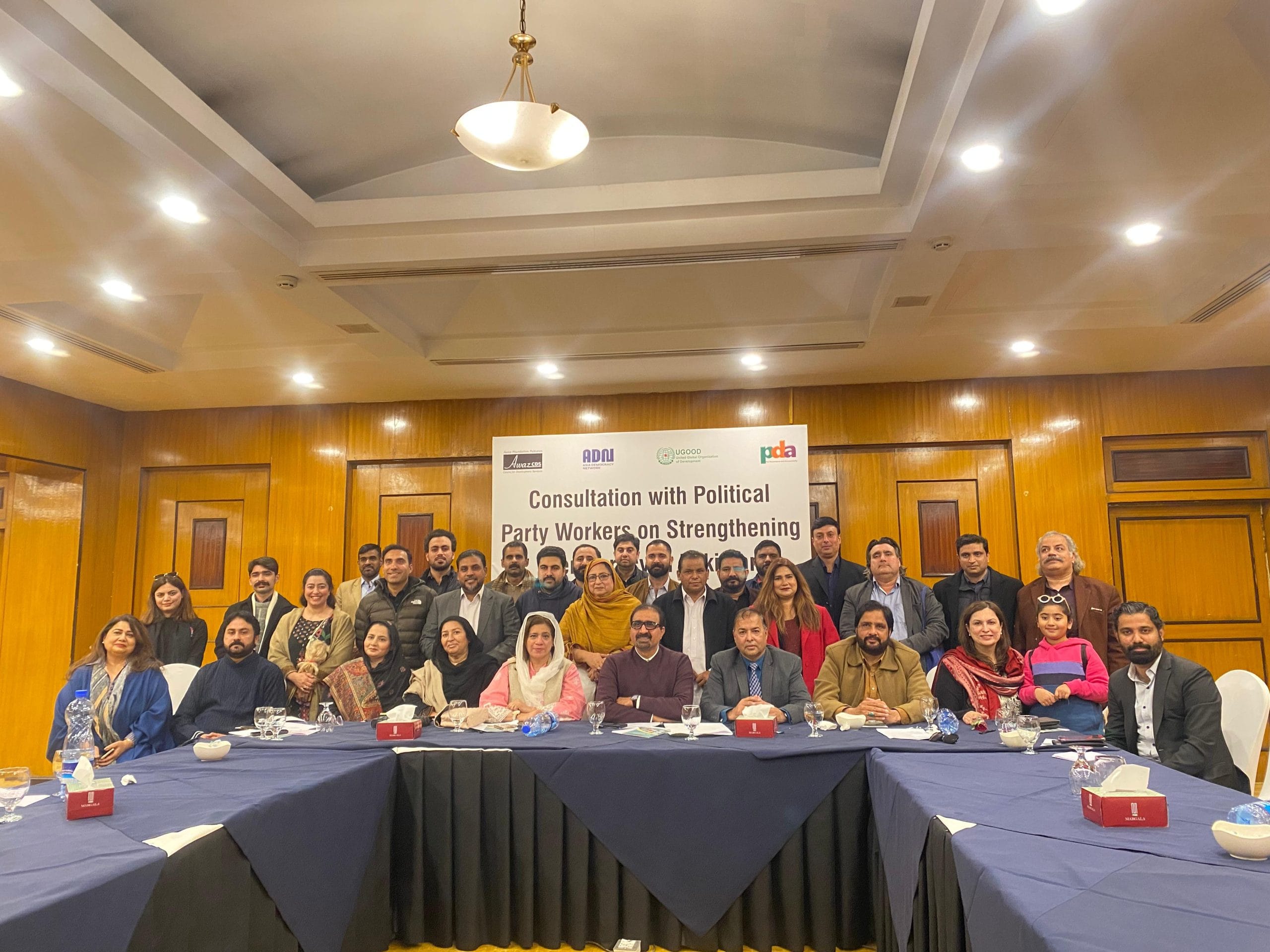
Political Workers demanded intra-party democracy, a truth and reconciliation commission, and a national commission for democracy to address the country’s present political polarization.
Islamabad. A session to promote and strengthen democracy in Pakistan emphasized the need to update the Charter of Democracy (CoD) into CoD 2.0 to address current political and governance challenges. The event brought together political workers from various national and regional parties in the country, mainly the Pakistan Peoples’ Party, Pakistan Muslim League Nawaz, Pakistan Muslim League (Q), Pakistan Tehrik-e-Insaf, Mutahhida Quomi Movement (MQM), and others.
The Pakistan Development Alliance organized the event to share the commitments of political parties in their manifestos for the general election on February 8th, 2024. Syed Ishtiaq Ul Hassan Gillani, CEO of UGOOD, highlighted the enduring significance of the original Charter of Democracy, which was introduced in 2006.
He reflected on how the charter laid the groundwork for constitutional, social, and economic reforms, aiming to create a more inclusive and democratic framework for the nation. He recounted milestones achieved between 2006 and 2018, such as establishing the National Commission for Human Rights and the National Commission on the Status of Women and introducing progressive laws promoting education and women’s rights.
Mr. Gillani emphasized that COD 2.O has been designed to address the shifting dynamics of Pakistan’s political landscape. He noted that the revised charter reaffirms the need for dialogue and unity among political forces to overcome national challenges. Highlighting the role of civil society, he praised the continued efforts of organizations such as the Pakistan Development Alliance and others to keep the democratic spirit alive.
Speaking at the event, Mr. Zia ur Rehman, Chief Executive of Awaz CDS-Pakistan, provided further insights into COD 2.O and its necessity. He explained that the original charter’s vision was built on 36 critical points encompassing political, economic, and social reforms. He celebrated the accomplishments achieved under the original charter, including the landmark 18th Amendment, which granted autonomy to provinces and devolved 27 ministries. Other significant achievements included establishing the NFC Award, the Islamabad High Court, and various commissions, such as the National Commission on the Rights of Children.
Mr. Rehman emphasized that the political changes in recent years, including the emergence of new leadership in established parties and the rise of new political entities like PTI, created a pressing need for COD 2.O. This updated charter focuses on fostering dialogue and collaboration among all political stakeholders. He noted that COD 2.O was developed through extensive consultations with civil society, political leaders, media representatives, and academic institutions. The finalized document was presented in both Urdu and English, and its importance was widely recognized when political parties inculcated the demands in their respective political manifestoes.
Participants at the event, including political leaders and workers from various parties, expressed their views on COD 2. O and underscored the importance of dialogue, peaceful conflict resolution, and collaboration in strengthening democratic values in Pakistan. Their collective commitment reflects a shared vision for sustainable development and a democratic future for the country. They said political parties are nurseries of political processes and democracy, and political workers are their backbone.
However, political workers are often neglected in leadership positions. They demanded intra-party democratic processes to strengthen democracy in the country further. The conversation of political workers also resolved that establishing the Truth & Reconciliation Commission is the viable solution to redress the country’s polarization. They also endorsed the demand for the creation of a National Commission for Democracy to ensure the supremacy of the Constitution and avoid derailments of democratic governance in the country.
