
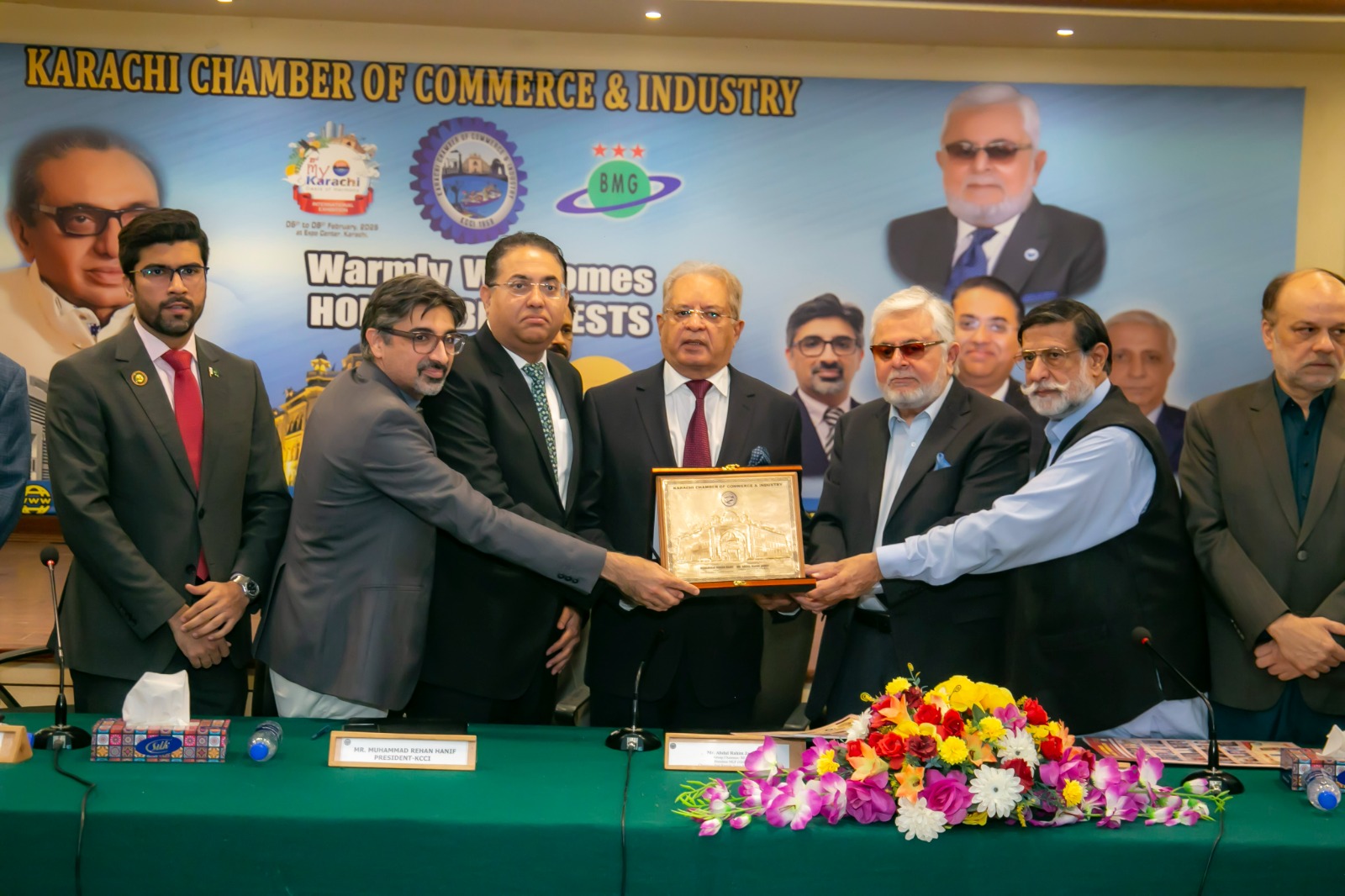
Group Chairman, Rice Exporters Association of Pakistan (REAP), Abdul Rahim Janoo said, “Things are not good for rice as exports are going down the hill, and this year presents serious challenges for rice exporters, many of whom are operating at a loss, barely able to cover overheads.
Exchanging views at a meeting during the REAP delegation’s visit to KCCI on Tuesday, Abdul Rahim Janoo warned that current trends are worrying, as exports are now declining and the sector is facing multiple challenges, including burdensome taxes and policy uncertainty.
Former Chairman Senate of Pakistan Mohammad Mian Soomro, Chairman Businessmen Group Zubair Motiwala, President KCCI Muhammad Rehan Hanif, Senior Vice President Muhammad Raza, Senior Vice President REAP Jawed Jilani, Former Chairman REAP Abdul Qayyum Paracha, Former President Junaid Esmail Makda, KCCI Executive Committee Members.
Abdul Rahim Janoo recalled that when he assumed charge as Chairman of REAP, Pakistan’s rice exports stood at roughly US $300 million. Under REAP’s active promotion, including trade delegations, global outreach, and marketing efforts such as the Biryani Festival, exports had surged to nearly US$4 billion, but unfortunately, they are declining this year.
He expressed concern that many rice exporters who run parallel businesses in real estate, the stock market, or earn on deposits are increasingly subjected to more taxes, further eroding investor confidence and hurting rice-export activities.
“KCCI and REAP must hold regular consultations to resolve the issues faced by rice exporters”, he urged while inviting KCCI leadership to visit REAP for detailed discussions on sector-wide challenges. He reaffirmed full unity with KCCI and emphasised the urgency of collective action to revive rice exports and safeguard the interests of the export-oriented industry.
He also commended the concept of the Biryani Festival. He called on Karachi Chamber to invite all diplomats to be hosted by REAP, providing a unique opportunity to showcase Pakistani rice through “four to five varieties of biryani” to international guests, a strategy that he believed will help market Pakistani rice abroad more effectively.
Chairman BMG Zubair Motiwala stated that rice plays a leading role in Pakistan’s economy, with exports worth US$4 billion, making it the country’s second-largest export after textiles. However, the decline in rice exports from US$4 billion to US$2.6 billion represents a staggering reduction that Pakistan cannot afford. “A fall of US$1.5 billion in exports is alarming for a country like ours”, he emphasised while urging the government to take urgent measures to arrest the downward trend in rice exports.
He added that although the government continues to make tall claims—pointing to a strong stock market, surplus trade accounts, and improved foreign exchange reserves, the key question remains whether exports have actually increased, and the answer is no. He explained that the improvement in reserves is largely due to the enhanced contribution of overseas Pakistanis, who sent US$38.5 billion in remittances. “It is deeply concerning and embarrassing for the entire business community that while more than one million overseas Pakistanis can send US$38 billion, our business community collectively struggles to achieve even US$32 billion in exports”, he remarked.
He stressed that Pakistan’s true export potential is not US$32 billion but at least US$150 billion, a target that can only be achieved through value addition rather than exporting raw commodities. Citing examples, he noted that countries like Thailand produce a wide range of rice-based value-added products, including cereals, and earn substantial revenues, whereas Pakistan continues to export rice in raw form only. He encouraged REAP to undertake research and development to educate stakeholders about the benefits of value addition in the rice sector, thereby significantly enhancing overall export value.
He added that the profitability of industries can be judged from the fact that many are not even in a position to undertake essential Balancing, Modernisation and Replacement (BMR) activities, which are critical for keeping industrial operations sustainable. A major portion of industrial revenue is being consumed by rising input costs, particularly exorbitant gas tariffs, which have severely undermined their viability.
He said that industries are currently passing through an extremely difficult phase, and therefore, collective and urgent efforts are needed to pull the economy, industrial sector, and exports out of the ongoing crisis.
Earlier, President KCCI Muhammad Rehan Hanif, while speaking to the REAP delegation, appreciated the consistent and overwhelming support extended by REAP members to the ruling group of the Karachi Chamber.
He noted that although rice exports had continued to rise over the past 4 to 5 years, they were now declining. “We look forward to hearing Rahim Janoo’s perspective on this important matter”, he added, while assuring REAP of KCCI’s full support and cooperation in addressing any issues they may be facing.
