
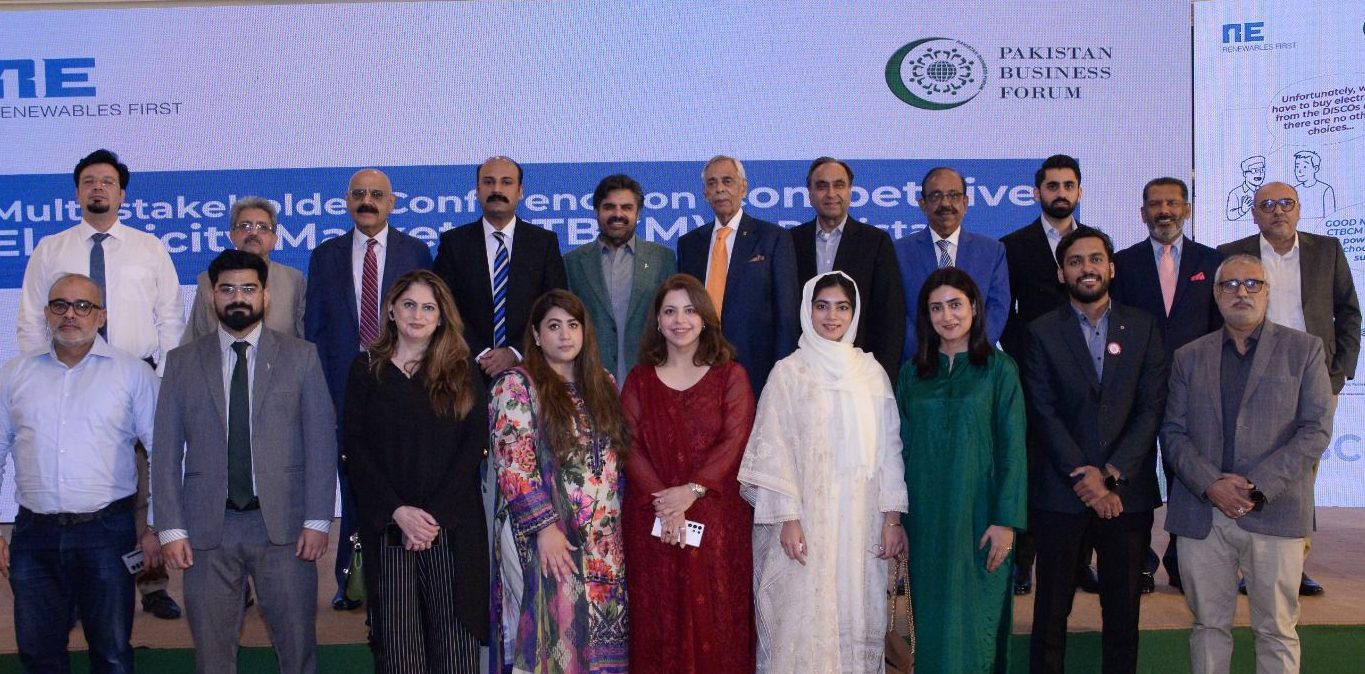
Sindh Energy Minister Syed Nasir Shah announced that the government supports the business community. The Sindh government has already established the Sindh Electric Power Regulatory Authority (SEPRA) to address provincial electricity matters. Additionally, the government plans to discuss the issues faced by business communities at both the provincial and federal levels.
Organized by Renewables First and the Pakistan Business Forum (PBF), with support from the Private Power & Infrastructure Board (PPIB), the Multi-Stakeholder Conference on the Competitive Electricity Market in Pakistan aims to transition from the current monopolistic, single-buyer model to a transparent, multi-stakeholder competitive system. This new model would allow for the direct trading of electricity between producers and consumers.
The conference began with a keynote speech from Chief Organiser PBF, Ahmad Jawad, CEO Renewables First, Zeeshan Ashfaq, and Tauseef H. Farooqi, former chairman of NEPRA, who highlighted the significance of moving towards a competitive electricity market for affordable electricity and Pakistan’s economy. The Competitive Trading Bilateral Contracts Market (CTBCM) is a thirty-year-old reform program that the Economic Coordination Committee and NEPRA have approved, but remains to be operationalized. In the conference, Salman Amin, member of the Competition Commission of Pakistan, highlighted that the monopolistic structure of Pakistan’s power sector remains a major concern. With the help of CTBCM, we can finally move towards competition and efficiency.
Abdul Rehman, Associate at Renewables First, explained the elements and history of the CTBCM reform, noting that the government has decided to launch the competitive electricity market with an initial 800MW, with plans to increase this capacity in the future. His remarks were followed by the first panel discussion featuring Tahir Basharat Cheema, former MD PEPCO; Amjad Ali Raja, CEO Thar Energy Ltd HUBCO; and a representative from the Independent System and Market Operator (ISMO). All emphasized the need to open the market for bilateral electricity trade to ensure fair competition and transparency. Mr. Cheema stated that poor institutional decisions had crippled the power sector.
Mr. Tauseef highlighted that the government failed to attract a single bid for a 600MW solar plant, while KE completed an auction for 640MW. Both stressed that if the government eased its control and allowed private sector participation, it could generate funds and create business opportunities. Another key point raised was that the government must be transparent in its planning and operations, avoiding closed-door decision-making.
The second panel included Junaid Naqi, President of the Korangi Association of Trade and Industry, Mujtaba Khan, CEO of Reon, Rehan Javed, FPCCI, and Saleha Hassan, PBF. Mr. Mujtaba stated that without serious reforms, the national electricity grid was headed for collapse, and the government must consult industrial stakeholders to figure out the way forward. He further added that the weakest link in the power sector chain is the distribution companies, their performance is poor, pushing consumers to go off-grid.
Ramsha Panhwar, researcher and energy specialist from Renewables First, highlighted the importance of a clean, cheap, and reliable supply of electricity for the industries that the government has so far failed to deliver. She informed the audience that over 80% of the proposed wheeling is composed of stranded costs and cross-subsidies, making open access prohibitively expensive. Instead, the government must opt for a phased and transparent recovery mechanism that does not burden ordinary consumers while, at the same time, making the wheeling charges attractive for industrial stakeholders.
In the conference, researchers and industrialists collectively demanded that the government provide a clear, consistent, and long-term plan for the recovery of stranded assets and ensure market growth under CTBCM. They also demanded that the government not limit the market size to 800 MW, which was too small. The market appetite is much larger, said Mr. Mujtaba Haider, and if provided fairness in wheeling and facilitation, the industry would happily participate.
The panel discussions were followed by remarks from President PBF Karachi Malik Khuda Bakash, who commended the efforts of stakeholders to organize the conference around such critical issues.
